Service
From our first foray into the building industry through to our latest product innovations, Manthorpe Building Products has grown year on year thanks to a philosophy of continuous investment and development.
Read more
Scotland’s decision to mandate swift nesting bricks in all new residential developments marks a defining moment for the construction industry. It elevates biodiversity from a planning aspiration to a regulatory requirement, reinforcing the principle that nature-positive design must now sit alongside energy efficiency, safety and build quality as a core component of modern housing delivery.
Swifts are among the UK’s fastest-declining bird species, with population losses closely linked to changes in how buildings are designed and constructed. As homes have become more airtight and elevations increasingly sealed, the natural cavities swifts rely on for nesting have all but disappeared. For many years, the industry recognised the issue, but practical solutions were often placed in the “too difficult” box — perceived as disruptive to build programmes, costly to deliver, or reliant on awkward retrofitting after completion.
That changed when Barratt Homes approached Manthorpe with a clear and practical challenge: to design a swift nesting solution that could be installed as part of the build process itself. The brief was uncompromising. The product had to be quick and easy to install, cost-effective, and capable of being fitted without impacting build schedules or site workflows. In short, it needed to behave like a standard brick while delivering a genuine ecological benefit.
The result was the original Manthorpe Swift Nesting Brick — a purpose-designed solution that demonstrated biodiversity could be integrated into housing delivery without adding risk or complexity. Crucially, conservation expertise was embedded from the outset. The RSPB and Action for Swifts worked alongside Manthorpe during development to ensure the brick provided the correct space, access and protection needed for swifts to nest and thrive. This collaborative approach helped bridge the long-standing gap between ecological ambition and construction reality.
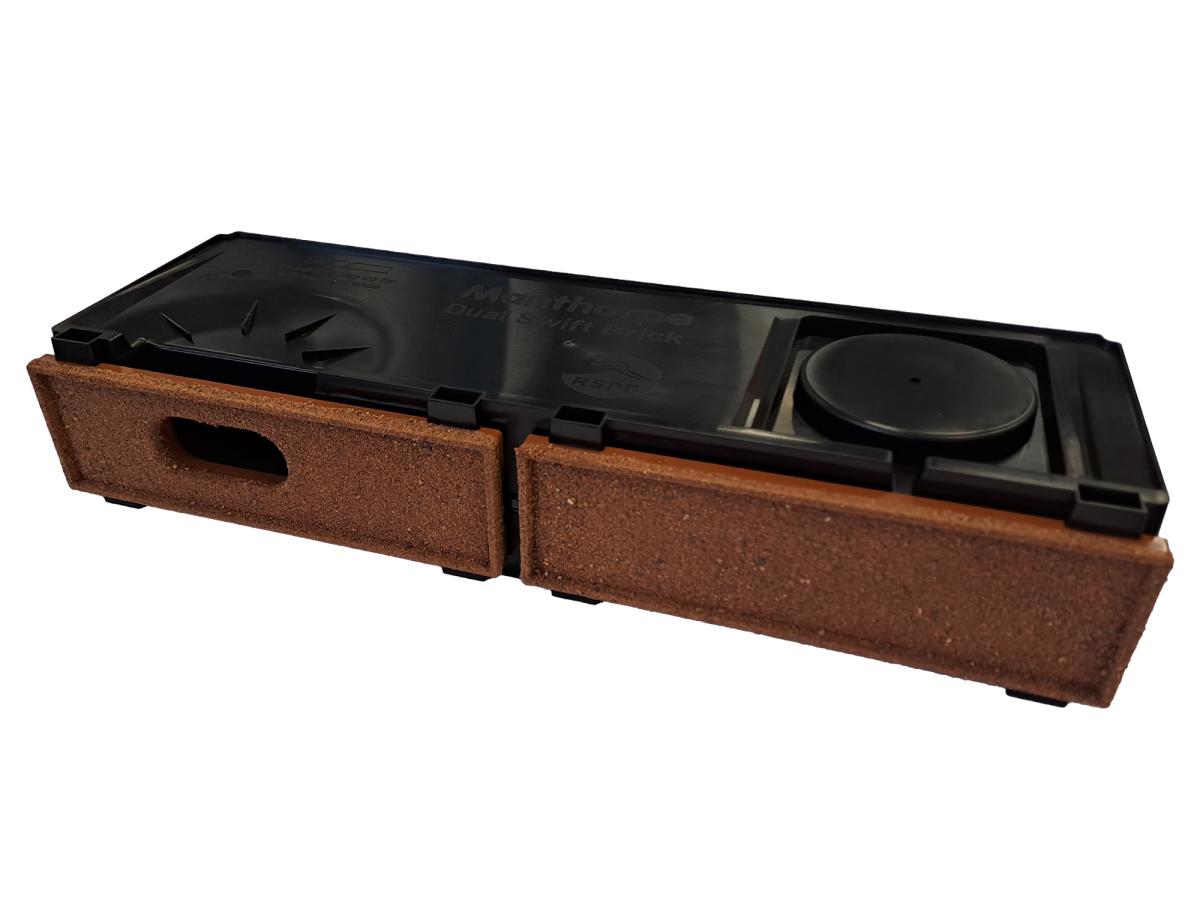
That same partnership ethos carried through to the development of the Dual Swift Nesting Brick, with the RSPB again providing guidance on the next evolution of the design. Today, the Dual Swift Nesting Brick is the predominant solution used across Scotland — a reflection of how closely it aligns with Scottish construction methods.
Much of Scotland’s new housing is delivered using timber-frame construction, often combined with narrow cavity walls. Designed to perform in cavities down to 50mm, the Dual Swift Nesting Brick is ideally suited to these build types, allowing developers to meet biodiversity requirements without altering wall build-ups or compromising thermal performance. Its ambidextrous design allows installation on either side of the wall, providing flexibility on site and reducing the potential for delays.
Replacing two standard bricks, the unit blends seamlessly into the masonry façade while providing a spacious nesting area for swifts. Installation is straightforward during construction, using standard bricklaying techniques, and the product can also be fitted retrospectively, extending its relevance to refurbishment and existing buildings.
Scotland’s mandate demonstrates what is possible when regulation, industry collaboration and intelligent product design align. It sets a clear precedent: biodiversity no longer sits at the margins of construction — it is becoming part of the fabric of how we build.
From our first foray into the building industry through to our latest product innovations, Manthorpe Building Products has grown year on year thanks to a philosophy of continuous investment and development.
Read moreAt Manthorpe we pride ourselves on our high quality standards, not just for the products that we produce; but for our design, manufacture, sales and delivery processes as well.
Read moreInnovation has always been at the core of the company. From new technology investment to in-house research and development, Manthorpe is constantly looking ahead to meet the needs of the industry.
Read more