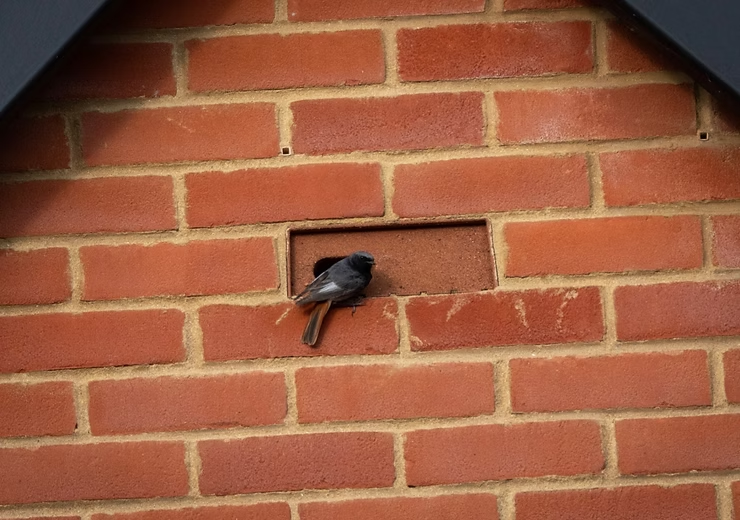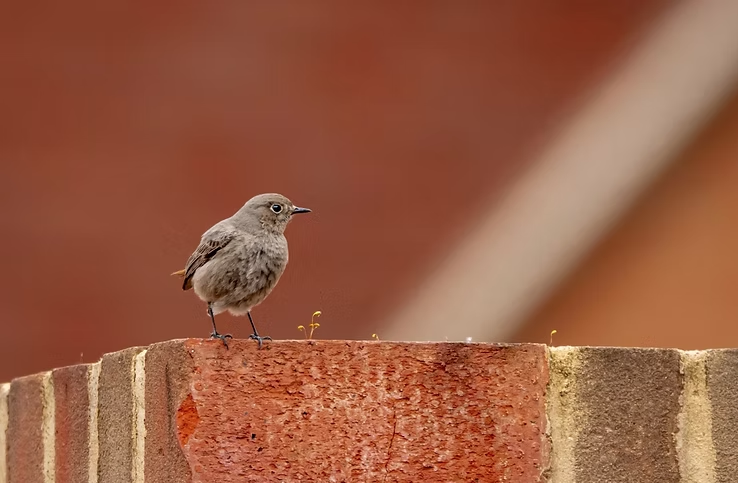

A recent wildlife sighting in Hampshire has highlighted the important role that integrated nest features can play in supporting some of the UK’s rarest bird species. A pair of Black Redstarts — a scarce breeder in Britain — has been observed investigating a Manthorpe Swift Nesting Brick as a potential nesting site.
The discovery, first reported by Hampshire Swifts and captured by photographer Grant Mintram, offers an encouraging glimpse into how thoughtfully designed building features can help nature adapt and recover in modern urban environments.
A rare visitor in an urban landscape
The Black Redstart (Phoenicurus ochruros) is a small, robin-sized bird more commonly found across Central and Southern Europe. In the UK, however, it is considered rare, with only a handful of breeding pairs recorded annually.
Historically, these birds nested in rocky, mountainous environments, favouring crags and crevices. Over time, they have adapted to urban landscapes, particularly post-industrial and post-war sites where buildings mimic their natural habitats. Despite this adaptability, suitable nesting opportunities remain limited, contributing to their scarcity.
An unexpected choice: a swift brick
In a notable turn, the Hampshire pair has been seen repeatedly entering and exploring a cavity within a Manthorpe Swift Nesting Brick — a structure originally designed to support Swifts and other small cavity-nesting birds.
Swift bricks are integrated into the fabric of buildings, providing safe, long-lasting nesting spaces that are protected from weather and disturbance. While commonly used by species such as House Sparrows, Blue Tits, and Starlings, their use by Black Redstarts is believed to be extremely unusual.
The Manthorpe brick in question features a relatively generous internal space compared with many designs, which may make it particularly appealing to a wider range of species. This adaptability underlines an important point: when designed thoughtfully, even species-specific features can deliver broader biodiversity benefits.
Designing for nature in modern construction
Modern building methods have largely eliminated the gaps and crevices that birds once relied on to nest. As homes have become more energy-efficient and sealed, opportunities for wildlife have diminished.
Integrated solutions like swift bricks offer a practical way to address this — providing nesting opportunities without compromising building performance. Increasingly, guidance for new developments recommends the inclusion of these features as part of a wider commitment to biodiversity.
In the Hampshire development where this sighting occurred, a range of measures — including swift bricks, bat boxes, and other wildlife features — have been incorporated. The result is a built environment that not only accommodates people but also supports local ecosystems.
A small brick, a bigger impact
While it remains to be seen whether the Black Redstart pair will successfully nest, their interest alone is significant. It demonstrates how relatively small interventions can create opportunities for species that might otherwise struggle to find suitable habitats.
For Manthorpe, it is a reminder that products designed to support one species can contribute more widely to nature recovery when placed in the right environment. More importantly, it reinforces the growing understanding that biodiversity can — and should — be considered an integral part of how we design and build our homes.
Manthorpe would like to acknowledge Hampshire Swifts for sharing this story. The original article and accompanying photography by Grant Mintram can be viewed on the Hampshire Swifts website A Swift brick attracts a pair of rare birds.